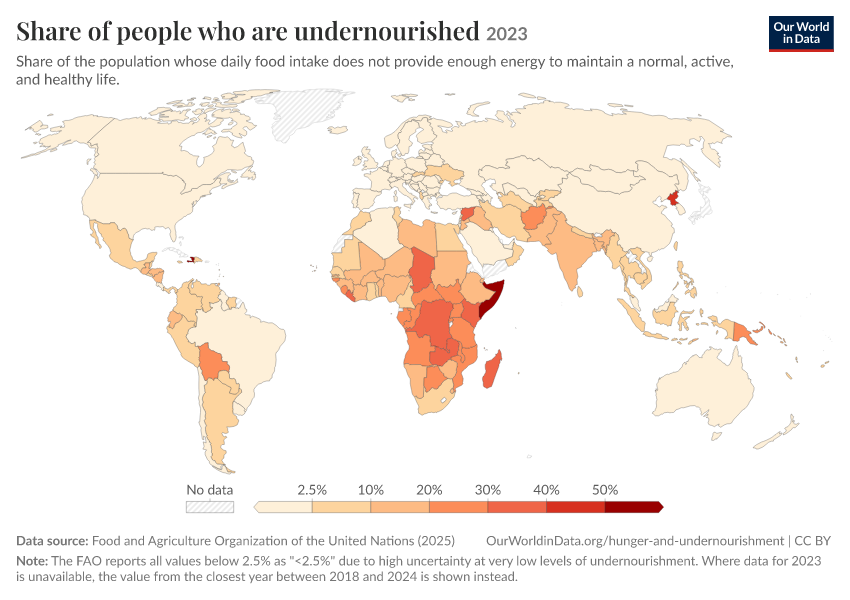
An estimated 645 million people faced hunger in 2025, or 7.8 percent of the world's population. That is nearly 14 million fewer than in 2024 and 43 million fewer than at the 2022 peak, according to the UN report The State of Food Security and Nutrition in the World 2026, published on 21 July. 645 million is about 107 times Denmark's population of 6,031,699 on 1 July 2026. The fall is the third in a row.
- Decided by
- FAO, IFAD, UNICEF, WFP and WHO, in The State of Food Security and Nutrition in the World 2026.
- Reach in Denmark
- Almost everyone
What has been decided
The report is the annual official UN assessment of hunger and food insecurity, prepared by FAO, IFAD, UNICEF, WFP and WHO. In the running text the report uses 645 million as the 2025 point estimate. The table of the number of undernourished people puts the figure at 644.6 million in 2025 and 658.8 million in 2024. FAO's newsroom writes that this is nearly 14 million fewer than in 2024. The prevalence fell from 8.1 percent in 2024 to 7.8 percent in 2025.
Broader food insecurity also eased. In 2025 about 2.1 billion people experienced moderate or severe food insecurity, nearly 86 million fewer than a year earlier, according to FAO's newsroom. The largest gains were recorded in South America and Asia, especially Southern Asia. At the same time, 2.69 billion people, 32.7 percent of the world's population, still could not afford a healthy diet.
Africa turned an upward trend: the share facing hunger fell from 20.3 percent in 2024 to 20.0 percent in 2025, the first interruption of the rise since 2017. Even so, about 309 million people in Africa remained undernourished, more than the 292 million in Asia, and 32 million in Latin America and the Caribbean. FAO warns that the absolute number in Africa may still rise because the population is growing.
FAO Director-General QU Dongyu said at the launch that the figures show hunger is not inevitable, and that strong economic policies, social protection and sustained investment in more efficient, inclusive, resilient and sustainable agrifood systems can bend the hunger curve. The report projects that around 520 million people could still face hunger in 2030, leaving the world off track for the goal of ending hunger. The Director-General warned that the estimate may underestimate the risk, because it does not fully account for a possible strong El Niño or recent cuts in development and humanitarian financing.
What it means for Denmark
Denmark is a signatory to the goal of ending hunger and contributes to the UN system that publishes the report. The figures are global and broken down by region; they do not replace the country-level hunger emergencies in, among other places, Sudan, South Sudan, Yemen, Somalia, Afghanistan and Nigeria, which have their own items. They do show that the overall curve can fall while individual crises remain severe.
What to watch
Will the decline hold in 2026, or will the risks FAO itself names — El Niño and less aid — come through? Will Africa's share keep falling, or will the absolute number rise anyway? And how will the countries already documented as hunger emergencies in the related items fare?
Related items


Sources
- FAO, IFAD, UNICEF, WFP and WHO, The State of Food Security and Nutrition in the World 2026
- FAO, SOFI 2026 – Hunger not inevitable, 21 July 2026
- FAO, The State of Food Security and Nutrition in the World 2026, publication page
- FAO, Global hunger statistics and trends
- Statistics Denmark, FOLK1A, population 1 July 2026
Changelog
- The headline was changed from 'Global hunger' to 'Global hunger falls for the third year in a row', so that it says what is happening.
- The line chart of the number of undernourished people has been replaced with a world map of the share who are undernourished in 2023 (CC BY 4.0, Our World in Data after FAO 2025). The caption notes that SOFI 2026 has a more recent figure for 2025.
- Restored to an ordinary item by editor decision
- headline_value and previous_value moved into metrics. review_log corrected to tier none, because the existing 10 November line was never a genuine review at tier 1; the changelog on the same day already stated that the change is 2 percent. No baseline_value; the SOFI 2026 table on the same definition begins only in 2010.
- Image added: Our World in Data chart of the number of undernourished people worldwide (CC BY 4.0, data from FAO 2025). The caption notes that SOFI 2026 has a more recent figure.
- Item created from SOFI 2026, which shows a third consecutive annual fall in global hunger.
- Converted to the report fields report, headline_value, previous_value and report_published. The SOFI table from 658.8 to 644.6 million undernourished is a 2 percent change, so the item has no tier.