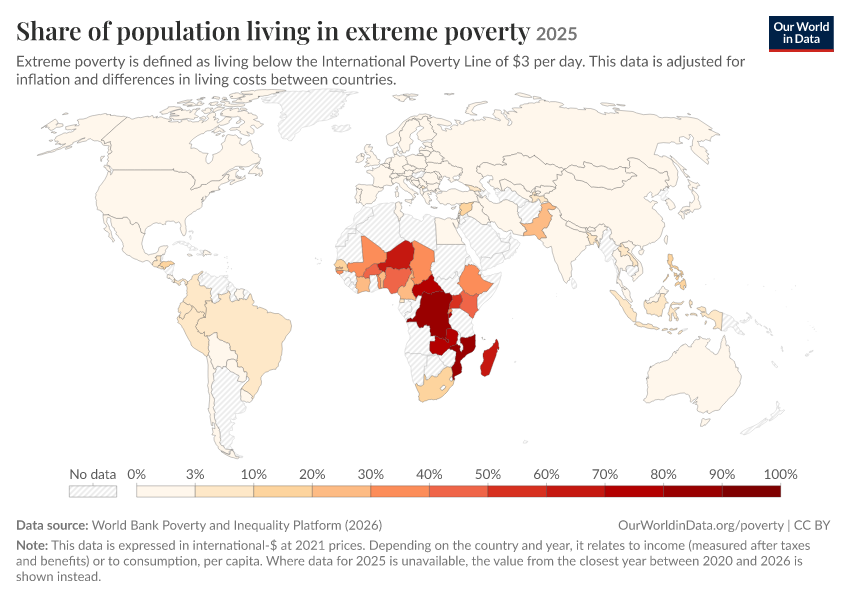
About 811 million people — one in ten in the world — lived in 2026 on less than 3.00 dollars a day, according to the World Bank's Poverty, Prosperity, and Planet report, published on 26 October 2026. That is the Bank's nowcast for 2026, and about 134 times Denmark's population of 6,031,699 on 1 July 2026. The Bank writes that progress in reducing extreme poverty has come to a standstill, and that the rate has essentially not changed since the pandemic.
- Decided by
- The World Bank, in the Poverty, Prosperity, and Planet Report 2026.
- Reach in Denmark
- Almost everyone
The standstill comes after a historic fall that almost nobody knows about. In 1990 more than one in three people — 43.4 percent, an estimated 2.3 billion — lived below the same 3.00-dollar-a-day line. By 2019 the share had fallen to 10.8 percent, about one in ten, an estimated 837 million people. The long story is told in the related item on the 30-year fall.
The long-term fall and the new line
Every figure here is measured against the World Bank's current line of 3.00 dollars a day in 2021 prices, taken from the Bank's Poverty and Inequality Platform in the September 2026 vintage. Years can be compared only when they are measured against the same line.
In 1990 the share was 43.4 percent, an estimated 2.3 billion people. In 2019 it was 10.8 percent, an estimated 837 million. The World Bank treats 2019 as a projection, because household surveys that year did not cover a sufficient share of the population in low-income and lower-middle-income countries. The direction is nonetheless clear: over three decades an estimated 1.46 billion people moved above the line. The fall was driven above all by robust, broad-based economic growth in East Asia and the Pacific and in South Asia. In East Asia and the Pacific the share fell from 67.0 percent in 1990, an estimated 1.218 billion people, to 2.6 percent in 2019. In South Asia it fell from 49.7 percent, an estimated 503 million, to 8.7 percent; the 2019 figure for South Asia is also a projection.
In 2020, during the pandemic, the share rose to 11.4 percent, an estimated 896 million people — about 59 million more than the year before. Since then the decline has almost stalled. In 2024, the latest year with sufficient household-survey coverage, 10.1 percent, an estimated 824 million people, lived below the line. The nowcast for 2026 is 811 million, or 9.8 percent. In Sub-Saharan Africa the share has fallen, but the absolute number has risen because the population has grown. The region had 61.5 percent in extreme poverty in 1990, an estimated 321 million people, and 45.0 percent in 2024, an estimated 581 million.
In June 2025 the World Bank raised the international poverty line from 2.15 dollars a day in 2017 prices to 3.00 dollars a day in 2021 prices. This is not simply inflation. The Bank writes that new price comparisons — purchasing power parities for 2021 — alone would have lifted the line by about 0.35 dollars, to 2.50 dollars. The rest, about 0.50 dollars, is due mainly to low-income countries revising their own national poverty lines, because they now measure household consumption more completely, including in West Africa. The higher line makes the latest count look higher. In the estimates the Bank published in June 2025, the number of people in extreme poverty in 2022 was revised up by about 125 million, from 713 million under the old line to 838 million under the new one. The two series must not be added together or compared across lines.
What has been decided
The report is the World Bank's official biennial stocktake of extreme poverty and shared prosperity. The Bank uses international poverty lines: 3.00 dollars a day measures extreme poverty on the standards used in low-income countries, while 8.30 dollars a day is the standard for upper-middle-income countries. According to the press release, nearly half the world's population — 3.7 billion people — still lives on less than 8.30 dollars a day, a number the Bank says has remained stagnant since 1990.
The Bank writes that extreme poverty is concentrated: more than half of the world's extremely poor live in just nine economies, and the Bank projects that an estimated 87 percent will by 2030 live in Sub-Saharan Africa or in fragile and conflict-affected settings. To bring extreme poverty down to 3 percent by 2050, per capita growth would, according to the Bank, need to average around 4 percent a year — twice the rate of the past 25 years. Without stronger per capita growth, the Bank projects that the number of people in extreme poverty will be higher in 2030 than it is today. These are the Bank's own projections, not a measured outcome.
What it means for Denmark
Denmark is part of the same international poverty targets that the report tracks, and of the development assistance that the UN has at the same time recorded at a historic low. The report does not give a separate Danish figure. What it changes is the official picture of whether world poverty is falling, and thus the basis for debate on growth, jobs and aid.
Pablo Saavedra, World Bank Group Vice President for Prosperity, said that in the countries where poverty is highest, slow growth has held back job creation and limited opportunities for millions of people, and that there is a need to accelerate growth and enable the creation of more and better jobs as a pathway out of poverty. Chief Economist Michael Kremer said that progress is possible, and that the report provides the framework for understanding the challenges and identifying the primary approaches for reducing poverty.
The Bank points to two tracks: closing employment gaps, including by closing the gender gap in employment rates, which according to the report could reduce global extreme poverty by roughly one-fifth, and closing earning gaps, including through education, which according to the report could raise predicted earnings by around 40 percent and cut extreme poverty nearly in half.
What to watch
Will the share living on less than 3.00 dollars a day move in the next edition, or will the standstill be confirmed? In fragile and conflict-affected countries, where the Bank expects a rising share of the extremely poor to live, access to data is often limited. That is a warning sign: poverty there may be undercounted. And how does the picture sit alongside FAO's account of global hunger, which fell for a third consecutive year in 2025, while extreme poverty, according to the Bank, has stalled?
Related items


Sources
- World Bank press release on the Poverty, Prosperity, and Planet Report 2026, 26 October 2026
- World Bank, Poverty, Prosperity, and Planet Report 2026
- World Bank, September 2026 Global Poverty Update, 22 September 2026
- World Bank, Poverty and Inequality Platform, 3.00 dollars a day (2021 PPP)
- World Bank, June 2025 Update to Global Poverty Lines
- World Bank, Poverty headcount ratio at $3.00 a day (2021 PPP)
- Statistics Denmark, FOLK1A, population 1 July 2026
Changelog
- The headline was changed from 'Extreme poverty in the world' to 'The fall in extreme poverty has stalled', so that it says what is happening.
- The line chart of the number of people in extreme poverty has been replaced with a world map of the share in extreme poverty in 2025, at the 3-dollar-a-day line (CC BY 4.0, Our World in Data after the World Bank Poverty and Inequality Platform 2026).
- Restored to an ordinary item by editor decision
- headline_value, previous_value and baseline_value moved into metrics. baseline_value is the 1990 figure 2,300,636,087 / 43.41 percent. review_log corrected to tier none, because the existing 10 November line was never a genuine review at tier 1; the changelog on the same day already stated that the change is 1.6 percent. status set to watch.
- Image added: Our World in Data chart of the number of people in extreme poverty, 1990–2026 (CC BY 4.0, data from the World Bank Poverty and Inequality Platform 2026).
- Item created from the World Bank's Poverty, Prosperity, and Planet Report 2026, published on 26 October 2026.
- Long-term fall 1990–2019 added on the same 3.00-dollar line, explanation of the shift from 2.15 to 3.00 dollars, and a link to the positive item fattigdom-30-aar. Jack's correction of 10 November 2026.
- Converted to the report fields report, headline_value, previous_value and report_published. From 824 million in 2024 to the 811 million 2026 nowcast, the change is 1.6 percent, so the item has no tier.