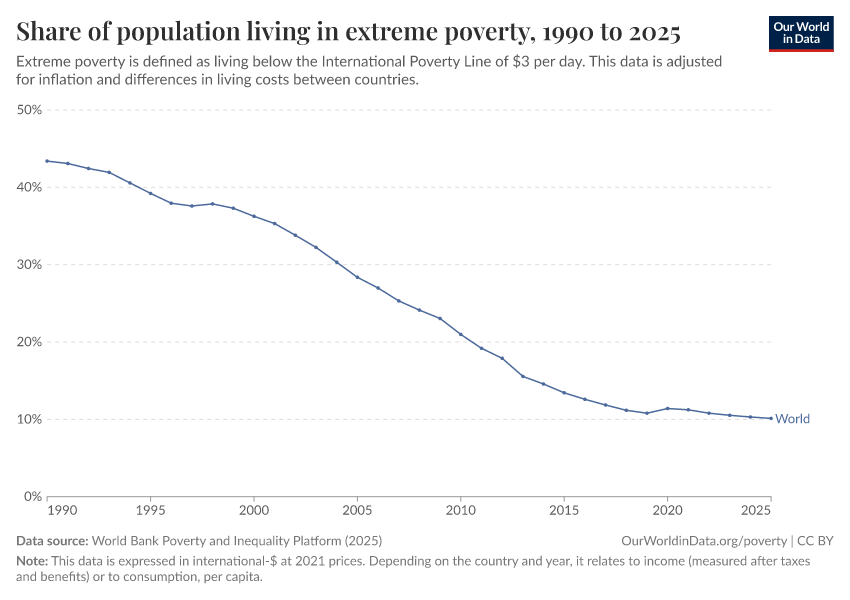
In 1990 more than one in three people in the world lived in extreme poverty. By 2019 it was about one in ten. On the same line — 3.00 dollars a day in 2021 prices — the share fell from 43.4 percent, an estimated 2.3 billion people, to 10.8 percent, an estimated 837 million, according to the World Bank's Poverty and Inequality Platform in the September 2026 vintage. An estimated 1.46 billion people moved above the line in three decades. 1.46 billion is about 243 times Denmark's population of 6,031,699 on 1 July 2026.
- Decided by
- The World Bank, in the Poverty and Inequality Platform and the Poverty, Prosperity, and Planet Report 2026.
- Reach in Denmark
- Almost everyone
This is one of the largest improvements in living conditions in modern times, and almost nobody knows it. The World Bank writes that the sharp decline was driven above all by robust, broad-based economic growth in East Asia and the Pacific and in South Asia.
What has been decided
Every figure in this item is measured against the current international poverty line of 3.00 dollars a day in 2021 prices. Years can be compared only when they are measured against the same line. The World Bank treats 2019 as a projection, because household surveys that year did not cover a sufficient share of the population in low-income and lower-middle-income countries. The direction of the series is nonetheless clear.
In East Asia and the Pacific the share fell from 67.0 percent in 1990, an estimated 1.218 billion people, to 2.6 percent in 2019, an estimated 61 million. In South Asia it fell from 49.7 percent, an estimated 503 million, to 8.7 percent, an estimated 140 million; the 2019 figure for South Asia is also a projection. In Latin America and the Caribbean the share fell from 20.7 percent to 6.2 percent.
Sub-Saharan Africa is a different picture. The share fell from 61.5 percent in 1990 to 43.9 percent in 2019, but the absolute number rose from an estimated 321 million to 500 million, because the population grew. Poverty therefore became increasingly concentrated there and in fragile and conflict-affected countries.
In 2020, during the pandemic, the global share rose to 11.4 percent, an estimated 896 million people — about 59 million more than the year before. Since then the decline has almost stalled. In 2024, the latest year with sufficient household-survey coverage, 10.1 percent, an estimated 824 million, lived below the line. The World Bank's nowcast for 2026 is about 811 million, or 9.8 percent — still about one in ten. That standstill, and what it means now, is set out in the related item on extreme poverty in the world.
In June 2025 the World Bank raised the line from 2.15 dollars a day in 2017 prices to 3.00 dollars a day in 2021 prices. This is not simply inflation. The Bank writes that new price comparisons alone would have lifted the line by about 0.35 dollars, to 2.50 dollars, and that the rest, about 0.50 dollars, is due mainly to low-income countries revising their own national poverty lines because they now measure consumption more completely. The higher line makes the latest count look higher, so the old and new series must not be compared across lines.
What it means for Denmark
Denmark is part of the same international poverty targets. The figures do not give a separate Danish number. What they change is the picture of what has already been achieved — and that the standstill since 2020 stands in contrast to three decades of decline, not in place of it.
What to watch
Will the share stay at about one in ten, or will the decline resume outside East and South Asia? How will the absolute number move in Sub-Saharan Africa, where the share has fallen but the count has risen? And will the next update keep the same 3.00-dollar line, so that the years can still be compared?
Related items


Sources
- World Bank, Poverty and Inequality Platform, 3.00 dollars a day (2021 PPP)
- World Bank, September 2026 Global Poverty Update, 22 September 2026
- World Bank, Poverty, Prosperity, and Planet Report 2026
- World Bank press release on the Poverty, Prosperity, and Planet Report 2026, 26 October 2026
- World Bank, June 2025 Update to Global Poverty Lines
- World Bank, Poverty headcount ratio at $3.00 a day (2021 PPP)
- Statistics Denmark, FOLK1A, population 1 July 2026
Changelog
- The headline was changed from 'From more than one in three to about one in ten' to 'Extreme poverty down from one in three to one in ten', so that it says what is happening.
- Image added: Our World in Data chart of the share of people in extreme poverty, 1990–2026 (CC BY 4.0, data from the World Bank Poverty and Inequality Platform 2026).
- Positive item created on the historic fall in extreme poverty from 1990 to 2019 on the same 3.00-dollar line, following Jack's correction of 10 November 2026.