Child mortality: 4.9 million children died before age five in 2024
World
- dead
- 4.9 million2024, children under five
Last reviewed · Last changed
Researched and written with AI · Method

An estimated 4.9 million children died before their fifth birthday in 2024, including 2.3 million newborns, according to the UN report Levels and Trends in Child Mortality, published on 18 March 2026. 4.9 million is about four-fifths of Denmark's population of 6,031,699 on 1 July 2026. It comes after a historic fall: in 1990 an estimated 13.0 million children under five died. The mortality rate fell from 93.5 to 37.4 deaths per 1,000 live births, a 60 percent decline — from about one in eleven children to about one in twenty-seven. The long story is told in the related item on the halving of under-five deaths.
Under-five deaths have fallen by more than half since 2000, but since 2015 the pace of reduction has slowed by more than 60 percent.
The long-term fall
UN IGME, which brings together UNICEF, WHO, the World Bank and the UN Population Division, is the UN's official source for the figures. In 1990 there were an estimated 13.0 million under-five deaths; the World Bank series, which is based on the same estimates, gives 12,970,030. In 2024 the rounded estimate was 4.9 million, and the series gives 4,857,797. That is nearly two-thirds fewer deaths a year than in 1990, about 8.1 million fewer, more than Denmark's population. UNICEF writes that the under-five mortality rate has fallen by about 60 percent since 1990, and that neonatal deaths — in the first month of life — have fallen by 45 percent, and that this has saved millions of young lives.
The progress is uneven, and the pace has slowed. In 2024 sub-Saharan Africa accounted for 58 percent of all under-five deaths. Southern Asia accounted for 25 percent. The report writes that this momentum is slowing, and that the current rate of decline points to 27.3 million under-five deaths between 2025 and 2030 unless it is raised.
The disease
The report is the UN's official estimate of how many children and young people are dying, where they are dying, and — for the first time — a full account of the causes of death. Most of these deaths can, according to the report, be prevented with proven, low-cost interventions and access to quality health care.
Among newborns, who account for nearly half of under-five deaths, the leading causes were complications from preterm birth (36 percent) and complications during labour and delivery (21 percent). Infections, including neonatal sepsis, and congenital anomalies also played a part. After the first month, infectious diseases such as malaria, diarrhoea and pneumonia were major killers. Malaria was the single largest cause of death in this age group (17 percent), especially in endemic areas of sub-Saharan Africa.
For the first time the report estimates deaths directly caused by severe acute malnutrition at more than 100,000 children aged 1–59 months, or 5 percent, in 2024. It writes that the toll is greater when indirect effects are counted, because malnutrition weakens immunity, and that malnutrition is often missing as an underlying cause of death. When the cause is not counted, that is a warning sign: the full toll is likely larger than the 100,000. Some of the countries with the highest numbers of direct deaths include Pakistan, Somalia and Sudan.
Where and who
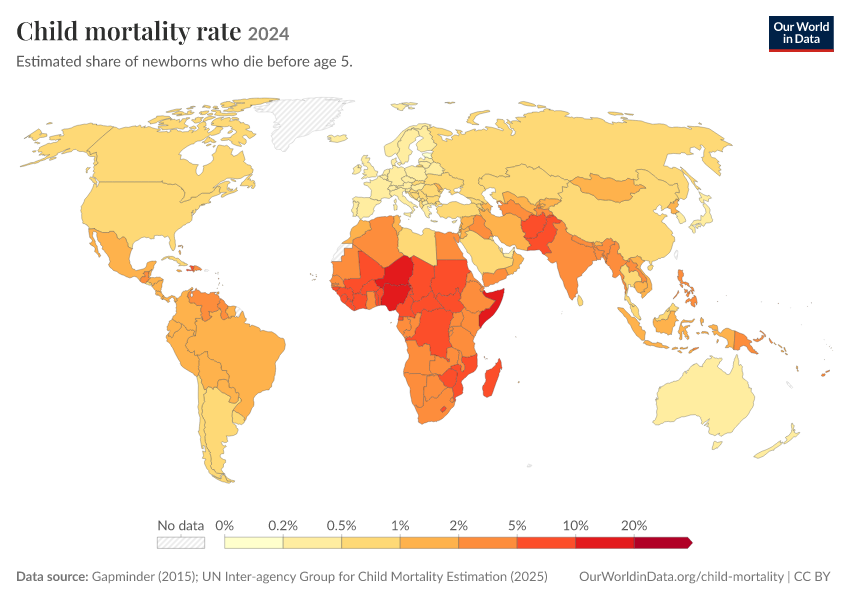
The deaths are heavily concentrated. In 2024 sub-Saharan Africa accounted for 58 percent of all under-five deaths. In the region, leading infectious diseases were responsible for 54 percent of those deaths. In Europe and Northern America the share was 9 percent, and in Australia and New Zealand 6 percent. Southern Asia accounted for 25 percent; there, mortality was driven largely by complications in the first month of life. After steep declines between 2000 and 2015, progress in reducing malaria mortality has slowed. Deaths remain concentrated in a handful of countries, including Chad, the Democratic Republic of the Congo, Niger and Nigeria, where conflict, climate shocks, invasive mosquitoes and drug resistance affect access to prevention and treatment.
The response
UNICEF writes that the gains since 1990 reflect decades of investment in immunization, essential health services, newborn care, nutrition support and the integrated management of childhood illnesses. The WHO press release highlights the same kind of proven, low-cost interventions: vaccines, treatment for severe acute malnutrition, and skilled care at birth. The report does not itself count how many children any one organisation treated. The UN Sustainable Development Goals Report 2026 writes that 134 countries have met the target for reducing child mortality, and that stunting among children under five has declined, leaving 30.2 million fewer stunted children between 2012 and 2024. That is a different measure from deaths, but it shows that some countries are moving while the global pace has slowed.
What to watch
Will the number of deaths keep falling, or is the slowdown since 2015 turning into a standstill? How will malaria deaths move in the countries the report names? And how will malnutrition, now counted as a direct cause of death, come through in the next estimate, especially in Sudan, Somalia and Pakistan?
Related items


The figures
| What | Figure | Period | As of | Source | Confidence |
|---|---|---|---|---|---|
| Dead, last 12 monthsThe UN's rounded estimate in the Levels and Trends in Child Mortality report, published on 18 March 2026. The figure includes 2.3 million newborns. The World Bank indicator SH.DTH.MORT, updated on 8 October 2026, gives 4,857,797 deaths in 2024 and 12,970,030 in 1990. | 4.9 million | 2024, children under five | UN IGME, UNICEF, WHO and the World Bank | Estimate |
All figures are minimums, not totals: documented cases are fewest exactly where access is worst. Grey rows are background and do not affect the placement.
Sources
- WHO, UNICEF, UN IGME and the World Bank, press release on Levels and Trends in Child Mortality, 18 March 2026
- UNICEF, Levels and Trends in Child Mortality 2025
- World Bank, Mortality rate, under-5 (per 1,000 live births), UN IGME
- World Bank, Number of under-five deaths, UN IGME
- Statistics Denmark, FOLK1A, population 1 July 2026
Changelog
- Photo added at the top: a mother holding her newborn skin to skin using kangaroo mother care at Laquintinie Hospital in Douala, Cameroon, 2021 (CC BY-SA 4.0, Happi Raphael). The world map of child mortality is now the second image.
- Headline clarified to name the subject
- The stacked area chart of child deaths by region has been replaced with a world map of the share of newborns who die before the age of five in 2024 (CC BY 4.0, Our World in Data after Gapminder 2015 and UN IGME 2025).
- Image added: Our World in Data chart of child deaths by region, 1990–2024 (CC BY 4.0, data from UN IGME via the World Bank 2026).
- Item created from the UN IGME report on child mortality, published on 18 March 2026.
- Long-term fall 1990–2024 added with the number, the rate and the framing from one in eleven children to one in twenty-seven, and a link to the positive item boernedoedelighed-halveret. Jack's correction of 10 November 2026.