Global displacement fell in 2025 for the first time in a decade
World
- displaced
- 68.6 millionstock of people internally displaced by conflict or violence at the end of 2025
- newly displaced
- 5.4 million2025, people who fled to another country
Last reviewed · Last changed
Researched and written with AI · Method
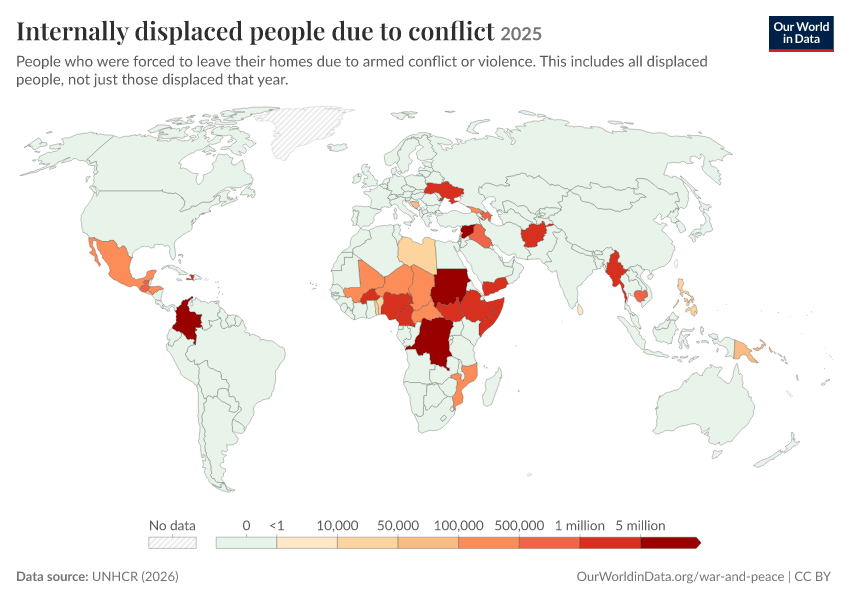
Global forced displacement fell in 2025 for the first time in a decade, but the level remains high, according to UNHCR's Global Trends report, launched on 11 June 2026 by High Commissioner Barham Salih. 14.7 million displaced people returned to their areas or countries of origin — 4.4 million refugees and 10.3 million internally displaced people — while 5.4 million people fled to another country.
The figures are minimums from different sources and periods — see the table below.
Who is fighting
The displacement comes from several conflicts, not one war. According to UNHCR, more than 70 percent of refugees and others in need of international protection originated from Afghanistan, South Sudan, Sudan, Syria, Ukraine and Venezuela. At the end of 2025 Sudan was the largest internal displacement crisis, with 9.1 million internally displaced people. The largest host countries were Colombia (2.8 million), Germany (2.7 million), Türkiye (2.4 million), Uganda (1.9 million), Iran (1.7 million), Chad (1.5 million) and Pakistan (1.3 million).
The report covers 2025. In the same press release UNHCR notes that the war in the Middle East, which began in February 2026, had by mid-May driven an estimated 1 million people into internal displacement in Lebanon, and that 3.2 million people were temporarily displaced in Iran at the end of March 2026. Those figures are not part of the 2025 stocktake.
Background
Salih said that for too many refugees, displacement starts as a lifeline but lasts a lifetime, and that humanitarian aid saves lives but is not the end point. 70 percent of refugees have been living in long-term displacement. He set a goal of reducing by more than half, over the next decade, the number of refugees in long-term displacement who rely on humanitarian aid, by expanding opportunities for voluntary return, relocation to a third country, and a shift from aid to self-reliance. Voluntary returns, he said, must be the primary solution. He stressed that asylum and protection are not up for debate.
The situation now
The number of refugees fell by 3 percent in 2025, to 41.6 million. Refugee returns were the second highest since records began 60 years ago, with a sharp increase in Afghanistan, Sudan and Syria. UNHCR also writes that many returns occurred under pressure and to precarious conditions at home. The number of people internally displaced by conflict or violence fell 7 percent, to 68.6 million. Arrivals through resettlement or sponsorship pathways fell by more than half year on year, to 81,800. Stateless people were estimated at 4.5 million at the end of 2025, 3 percent more than a year earlier. Nearly 46,000 stateless people acquired citizenship in 24 countries.
The UN Sustainable Development Goals Report, published on 7 July 2026, cites a combined total of more than 117.8 million forcibly displaced people worldwide at the end of 2025. UNHCR reports the stocks separately — 41.6 million refugees and 68.6 million internally displaced people — and does not add them into one combined total in its press release.
What to watch
Will the decline hold when the 2026 figures appear, once the new displacements in the Middle East are counted? How many of the 14.7 million who returned have stayed, and under what conditions? And will resettlement move from the 81,800 places, after falling by half in a single year?
Related items


The figures
| What | Figure | Period | As of | Source | Confidence |
|---|---|---|---|---|---|
| Newly displaced, last 12 monthsOnly people who in 2025 crossed a border fleeing violence and persecution. Newly internally displaced people are not included in this figure. | 5.4 million | 2025, people who fled to another country | UNHCR | Verified | |
| Displaced (internally + refugees)UNHCR cites the Internal Displacement Monitoring Centre's estimate. The figure fell 7 percent from the end of 2024. Refugees in other countries (41.6 million) are not included here. A combined UN figure of more than 117.8 million forcibly displaced people at the end of 2025 appears in the UN Sustainable Development Goals Report, which draws on several sources. | 68.6 million | stock of people internally displaced by conflict or violence at the end of 2025 | IDMC, cited by UNHCR | Estimate |
All figures are minimums, not totals: documented cases are fewest exactly where access is worst. Grey rows are background and do not affect the placement.
Sources
Changelog
- Headline clarified to name the subject
- The image URL now points explicitly to the 2025 map view, so the image is shown as a world map and not as a chart (CC BY 4.0, Our World in Data after UNHCR 2026).
- Image added: Our World in Data map of people internally displaced by conflict in 2025 (CC BY 4.0, data from UNHCR 2026).
- Item created from UNHCR's Global Trends report, launched on 11 June 2026, which shows the first decline in global forced displacement in a decade.