Malaria: 610,000 died in 2024, though the death rate has almost halved
World
- dead
- 610,000calendar year 2024
- cases
- 282 millioncalendar year 2024
Last reviewed · Last changed
Researched and written with AI · Method
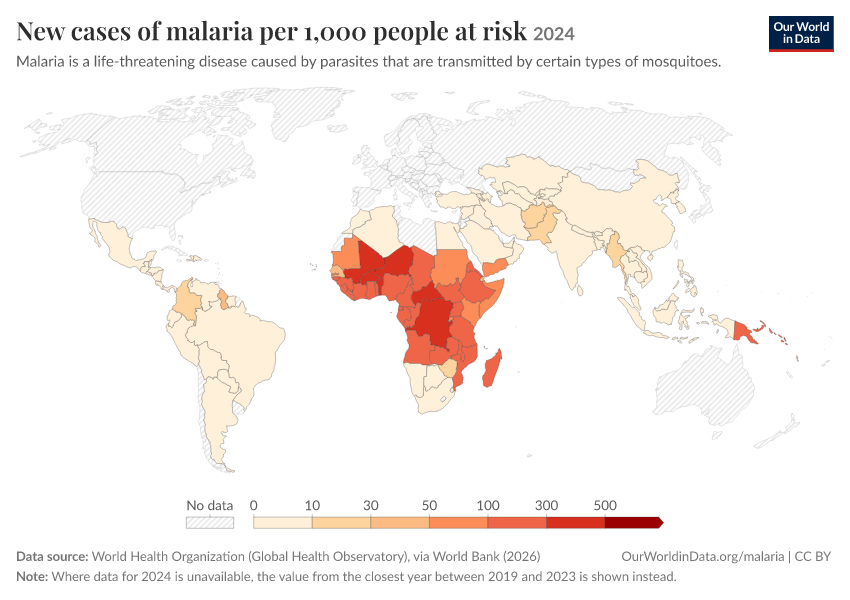
The malaria death rate has almost halved since 2000, and WHO estimates that 14 million deaths and 2.3 billion cases have been averted. Even so, an estimated 282 million people had malaria in 2024, and 610,000 died. That is about 9 million more cases than the previous year. The 610,000 deaths are close to the entire population of Copenhagen (670,389 on 1 July 2026, Statistics Denmark, FOLK1A).
The long-term fall
All figures here are WHO estimates in the World malaria report 2025, published on 4 December 2025. Rounded figures are estimates.
In 2000 there were an estimated 239 million cases and 864,000 deaths. Among people living where malaria can spread, 79.4 out of every 1,000 got the disease – about one in 13. The death rate was 28.6 per 100,000 people at risk.
By 2015 the death rate had almost halved, to 14.9 per 100,000. The number of deaths had fallen by 33.1 percent, from 864,000 to 578,000. Incidence – new cases per 1,000 people at risk – fell by 25.6 percent, from 79.4 to 59.0. The number of cases itself fell only slightly, from 239 million to 230 million.
In 2024 the death rate was 13.8 per 100,000 people at risk, unchanged from 2023, and only 7.4 percent lower than in 2015. Incidence was 64.0 per 1,000, about one in 16, and thus 8.5 percent higher than in 2015. There were an estimated 282 million cases and 610,000 deaths. WHO writes that the number of deaths can rise even when the death rate falls, primarily because of population growth.
WHO estimates that 2.3 billion cases and 14 million deaths were averted between 2000 and 2024, by comparing the actual burden with what would have happened if the 2000 incidence and death rates had remained unchanged. In 2024 alone, more than 170 million cases and 1 million deaths were averted. About three in four of the avoided cases (75.8 percent) and more than nine in ten of the avoided deaths (93.3 percent) were in the WHO African Region. WHO writes that other changes, such as higher living standards and urbanization, may also have contributed.
The stall and its causes
Since 2015 the number of cases has risen by 22.6 percent and the number of deaths by 5.5 percent. More than one third of the rise in deaths came between 2023 and 2024. From 2023 to 2024 cases rose by about 9 million, or 3 percent; three countries – Ethiopia (up 2.9 million), Madagascar (up 1.9 million) and Yemen (up 378,000) – accounted for 58 percent of the increase.
The WHO African Region accounted for 94 percent of cases, an estimated 265 million, and 95 percent of deaths, an estimated 579,000, in 2024. According to WHO's fact sheet, children under five accounted for about three in four of the deaths in the region; the same page says both "about 75 percent" and "about 76 percent". Eleven countries account, according to WHO, for about two thirds of global cases and deaths.
WHO writes that the increase in 2024 was driven by a mix of technical, systemic, environmental and financial problems, concentrated in a limited number of countries. Resistance to the main tools is growing. WHO's news release on the report says that partial resistance to artemisinin – the main medicines against malaria after older drugs failed – has now been confirmed or suspected in at least eight African countries, and that there are signs that the drugs given together with artemisinin are also losing effect. Among the countries that reported testing in 2020–2024, resistance to pyrethroids, a common class of insecticide used on mosquito nets, was confirmed at least at one site in 48 countries. Some malaria parasites no longer produce the protein that many rapid blood tests look for, so the test can miss the infection.
At the same time, the tools are not getting through. There are gaps in surveillance, limited access to treatment, and frequent stock-outs of medicines and tests. Conflict and insecurity have disrupted health services. Changes in temperature and rainfall, and extreme weather, have altered mosquito habitats and damaged housing and supplies. Funding has levelled off. In 2024 total malaria funding was estimated at US$3.9 billion, a slight decline from US$4.0 billion in 2023, and it covered less than half of estimated need. The 2025 funding target in WHO's strategy is US$9.3 billion.
Three countries – Georgia, Suriname and Timor-Leste – were certified malaria-free in 2025. That story is told in the related item.
The disease
Malaria is transmitted by Anopheles mosquitoes carrying Plasmodium parasites. Most deaths are among young children in places where the disease is endemic. Treatment and mosquito nets have prevented many deaths since 2000, but resistance to drugs and insecticides is now eroding some of those gains. The 2025 report takes resistance as one of its main themes.
The response
WHO's Global Malaria Programme brings together national programmes, supplies of nets, diagnostics and medicines, and work on new tools, including vaccines in selected countries. The report says that new dual-ingredient nets and WHO-recommended vaccines helped prevent more than 170 million cases and 1 million deaths in 2024, and that by October 2025, 24 countries had introduced malaria vaccines into routine childhood immunization. It also warns that progress could be rolled back if resistance, funding shortfalls and unstable supplies are not addressed. The World malaria report 2025, covering 2024, is the latest comprehensive global assessment.
What to watch
The next World malaria report, which will show whether cases and deaths fell or rose again in 2025. Whether funding moves closer to need, and whether resistance to drugs and insecticides spreads. The trend in the countries that carry most of the burden. Whether more countries are certified malaria-free, as described in the related item.
Related items

The figures
| What | Figure | Period | As of | Source | Confidence |
|---|---|---|---|---|---|
| Dead, last 12 monthsWHO's rounded estimate in the World malaria report 2025, Table 2.1. The point estimate is 610,000 (95% interval 561,000–738,000). In 2000 the point estimate was 864,000 (833,000–904,000) and in 2015 it was 578,000. The death rate fell from 28.6 per 100,000 people at risk in 2000 to 14.9 in 2015 and 13.8 in 2023 and 2024. The African Region accounted for 95% of deaths in 2024, an estimated 579,000 (531,000–706,000). | 610,000 | calendar year 2024 | WHO | Estimate | |
| Cases, last 12 monthsWHO's rounded estimate in the World malaria report 2025, Table 2.1. The point estimate is 282 million (95% interval 256–313 million) in 80 endemic countries, including French Guiana. That is about 9 million more cases (3%) than in 2023, when the figure was 273 million. In 2000 the point estimate was 239 million (224–258 million) and in 2015 it was 230 million. Incidence fell from 79.4 per 1,000 people at risk in 2000 to 59.0 in 2015 and was 64.0 in 2024. | 282 million | calendar year 2024 | WHO | Estimate | |
| Declared public health emergency of international concern (PHEIC)The World malaria report 2025 treats malaria as a continuing global health challenge, not as a public health emergency of international concern. | No | malaria is endemic and has not been declared a PHEIC | WHO | Verified |
All figures are minimums, not totals: documented cases are fewest exactly where access is worst. Grey rows are background and do not affect the placement.
Sources
Changelog
- Headline clarified to name the subject
- The lead photograph of bed-net distribution in Madagascar has been replaced, so the existing world map of malaria incidence in 2024 is now the lead image (CC BY 4.0, Our World in Data after WHO via the World Bank). The photograph was removed because a smiling scene does not match the tone of the item, and because global items should use a topical world map as their image.
- Images added: bed-net distribution in Madagascar, 2016 (public domain, USAID), and an Our World in Data map of malaria incidence in 2024 (CC BY 4.0, data from WHO via the World Bank).
- Item created.
- The long-term trend since 2000, the stall and its causes have been added, and the item has been clearly distinguished from the positive item malaria-fri. Jack's decision of 10 November 2026.