"Grace be unto you, and peace, from him which is, and which was, and which is to come; and from the seven Spirits which are before his throne." — Revelation 1:4 (KJV)
One Spirit. Seven lights. And you were never meant to burn with only one.
Why do you feel at home in some churches and not in others?
Most of us worship God in one way, and quietly wonder what's wrong with everyone else. We settle where we already fit — and call it faithfulness. But what if the very thing that makes you comfortable is the thing keeping you from growing up?
Here is the whole message in one breath, and then we'll take it slowly. There are seven Spirits before God's throne — one Spirit, burning with seven lights. No believer, and no church, carries all seven equally. You blaze with one or two and flicker in the rest. You are not meant to become all the same — the body has many members — but you are strengthened by every light you are exposed to, and learning to honour all seven is what keeps us in the unity of the Spirit.
The seven lights
The seven are Truth, Holiness, Life, Power, Grace, Love, and Glory — seven facets of the one Holy Spirit. (Scripture pictures them as a lampstand with seven lamps, and even lists them once by name; we'll come to that below.)
Hold them for a moment simply as names, and watch what happens when you look honestly at your own walk, and at the church around you: hardly anyone shines in all seven.
Worship in spirit — or in truth?
"God is a Spirit: and they that worship him must worship him in spirit and in truth." — John 4:24
In my experience, people react in a funny way to this verse. Either they think less of themselves and get discouraged, feeling they fall short — or they get puffed up, sure that they worship in spirit and in truth while everyone else does not.
But my honest evaluation is that very few do both. Most worship Him either in spirit or in truth. In a very general way — with room for plenty of exceptions — some traditions lean toward worshipping in spirit, and others toward worshipping in truth. And if that is true of worship, it is true of the whole life of the Spirit. We are partial. We carry some of the lights and not the others.
Each tradition carries one light
Look across the church and its history and you see it plainly: almost every stream has carried one of these lights more brightly than the rest. God has spread His fullness across His whole body.
- Truth — the Reformers and the great Bible-teaching traditions. Luther recovering "Scripture alone"; the expositors and Bible colleges that ground people in the Word.
- Holiness — the Wesleyan and holiness movements, the Puritans, and the monastics, pressing after a clean heart and a disciplined life.
- Life — the revivalists and evangelists. The Great Awakenings; Billy Graham calling millions to be "born again."
- Power — the Pentecostal and charismatic streams. Azusa Street, and healing ministries like Smith Wigglesworth's, marked by signs and wonders.
- Grace — the houses of prayer and the intercessors. The Moravians' hundred-year prayer meeting; George Müller's life of trusting, praying faith.
- Love — the works of mercy. Mother Teresa among the dying in Calcutta; William Booth's Salvation Army — "soup, soap, and salvation"; Francis of Assisi among the poor.
- Glory — the worshippers and the liturgical traditions. The Orthodox liturgy that feels like heaven touching earth; the worship movements that live to behold and reflect His glory.
None of these is the whole Spirit — each is one lamp on the one lampstand. And that is exactly why we need one another.
The instinct that keeps us small
Here is what this means in practice — and it runs against every instinct we have. By nature we gravitate to where we are already strong, because that is where we feel we fit: where we are understood, affirmed, and comfortable. The lover of truth signs up for another teaching conference; the worshipper looks for another worship night. It feels right, so we assume it must be what we need.
But we do not grow into the fullness of Christ by staying where we are already strong. We grow by deliberately going where we are weak — putting ourselves under a stream that carries the light we are missing, precisely where it feels unfamiliar and uncomfortable, until that fire is kindled in us too.
- Weak in truth, no theological grounding? Sit under solid teaching — go to a Bible school or a church that is strong in the Word.
- Hungry for the Spirit's power or revelation? Spend a season in a church or school where that flows, and let them lay hands on you and pray.
- Short on mercy and love? Put your hands to work — serve in an outreach, a shelter, a relief program among the poor.
- Thin in grace and prayer? Join a house of prayer or an intercessory community for a while.
- Lacking holiness? Place yourself under discipleship and accountability that takes sin seriously.
- Never seen new life? Walk with people who lead others to Christ, and watch the dead come alive.
- Dry in worship and glory? Worship with a people who know His presence, until your own heart burns again.
You were never meant to shine with one light while the others stay dark. This is not disloyalty to your own tradition — it is how you grow up.
How do we live this out?
- It is okay if people are different from you, or see things differently.
- You can learn new things — you don't have to stick to one way of doing things.
- Allow yourself to break your limitations; be brave enough to do things you are not used to or comfortable with.
- Prayer and worship are an expression of your beliefs and feelings. They may be a way to express who you are, but they are not who you are. Your identity is in Christ, not in the way you express yourself.
That is the heart of it: one Spirit, seven lights; go and receive the ones you lack, and grow up into the fullness of Christ.
Going deeper: where this comes from
If you stop here, you already have the message. But the picture gets richer — and steadier under your feet — when you see it in Scripture. Here is the foundation it stands on.
Seven Spirits before the throne
John sees, again and again, that before the throne of God there are seven Spirits:
"…These things saith he that hath the seven Spirits of God, and the seven stars…" — Revelation 3:1
"…there were seven lamps of fire burning before the throne, which are the seven Spirits of God." — Revelation 4:5
"…a Lamb as it had been slain, having seven horns and seven eyes, which are the seven Spirits of God sent forth into all the earth." — Revelation 5:6
Seven is Scripture's number of fullness and completion. The seven Spirits are not seven separate beings — they are the one Holy Spirit in the fullness of His work. Revelation itself speaks just as freely of "the Spirit," singular ("what the Spirit saith unto the churches," Revelation 2:7). One Spirit, seen in a sevenfold blaze of light.
The lampstand: one lamp, seven lights
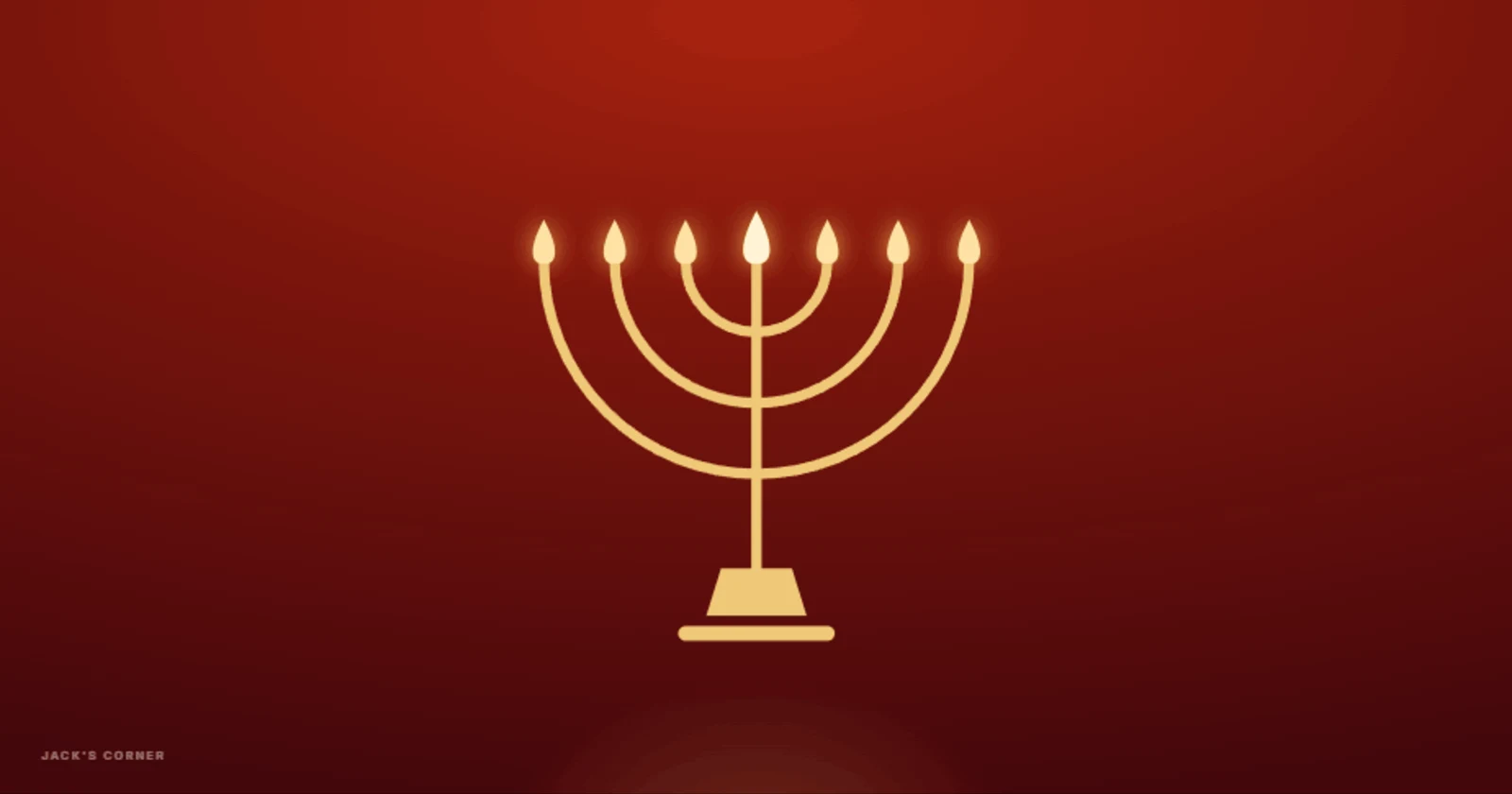
There is an object in Scripture that is literally one stand bearing seven lights — the golden lampstand (the menorah) of the tabernacle. It is one of the Bible's own pictures of the Holy Spirit.
"And thou shalt make a candlestick of pure gold… six branches shall come out of the sides of it… And thou shalt make the seven lamps thereof." — Exodus 25:31–37
The lampstand is explained as the Spirit:
"…a candlestick all of gold… and his seven lamps thereon… Not by might, nor by power, but by my Spirit, saith the LORD of hosts… those seven; they are the eyes of the LORD, which run to and fro through the whole earth." — Zechariah 4:2, 6, 10
And John sees the very same lamps before the throne (Revelation 4:5, above). So the lampstand preaches the whole message on its own: one lamp, seven lights — one Spirit, sevenfold fullness. The fire on it is the Spirit Himself (compare the tongues of fire at Pentecost, Acts 2:3).
Notice its shape: one central shaft with six branches coming out of it. That is the very shape of the one place Scripture actually lists the sevenfold Spirit.
The one place Scripture counts them: Isaiah 11:2
"And the spirit of the LORD shall rest upon him, the spirit of wisdom and understanding, the spirit of counsel and might, the spirit of knowledge and of the fear of the LORD." — Isaiah 11:2
One Spirit (the shaft) + six attributes (the branches) = seven. The number is not something we impose from outside; it is a pattern the text itself gives.
The names of the one Spirit
These seven are all the one Spirit, and Scripture names Him many ways: Spirit of God (Genesis 1:2), Spirit of the LORD (Judges 3:10; Isaiah 61:1; Luke 4:18), Holy Spirit (Psalm 51:11; John 14:26), Spirit of Christ / of His Son (Romans 8:9; Galatians 4:6), Spirit of Jesus (Acts 16:7; Philippians 1:19), Eternal Spirit (Hebrews 9:14), the Comforter (John 14:16, 26).
The seven, proven from Scripture
Reading every "Spirit of ___" across the Bible, the descriptions gather into the seven lights we named at the start:
I. The Spirit of Truth — the illumined mind; He reveals God and gives light to know Him. Truth — John 14:17; 15:26; 16:13; 1 John 4:6; 5:6. Wisdom — Exodus 28:3; Deuteronomy 34:9; Isaiah 11:2; Ephesians 1:17. Understanding, counsel, knowledge — Isaiah 11:2. Revelation — Ephesians 1:17. Prophecy — Revelation 19:10.
II. The Spirit of Holiness — sanctifying purity. Holiness — Romans 1:4. The Holy Spirit — Psalm 51:11. The fear of the LORD — Isaiah 11:2. The spirit of judgment and of burning — Isaiah 4:4; 28:6.
III. The Spirit of Life — regeneration and resurrection. Romans 8:2; Revelation 11:11; John 6:63 ("it is the Spirit that quickeneth"); the breath of life — Genesis 2:7; Ezekiel 37:5–14.
IV. The Spirit of Power (Might) — enabling strength. Might — Isaiah 11:2; Micah 3:8; Zechariah 4:6. Power — 2 Timothy 1:7; Acts 1:8; Luke 24:49; Romans 15:13, 19.
V. The Spirit of Grace — the redemptive, relational Spirit. Grace and supplication — Zechariah 12:10; Hebrews 10:29. Adoption — Romans 8:15; Galatians 4:6. The seal and promise — Ephesians 1:13–14. Faith — 2 Corinthians 4:13.
VI. The Spirit of Love — the fruit and character. Love — Romans 5:5; 15:30 ("the love of the Spirit"); 2 Timothy 1:7. Meekness — 1 Corinthians 4:21; Galatians 6:1. A sound mind (self-discipline) — 2 Timothy 1:7.
VII. The Spirit of Glory — the indwelling glory and crown. Glory — 1 Peter 4:14 ("the spirit of glory and of God resteth upon you"). The earnest of the inheritance — Ephesians 1:14; 2 Corinthians 1:22. The Eternal Spirit — Hebrews 9:14.
One body, one Spirit
Why can none of us hold all seven alone? Because God never gave them to be held alone. He gave them to a body.
"…endeavouring to keep the unity of the Spirit in the bond of peace. There is one body, and one Spirit, even as ye are called in one hope of your calling; one Lord, one faith, one baptism, one God and Father of all… And he gave some, apostles; and some, prophets; and some, evangelists; and some, pastors and teachers; for the perfecting of the saints, for the work of the ministry, for the edifying of the body of Christ: till we all come in the unity of the faith… unto the measure of the stature of the fulness of Christ… but speaking the truth in love, may grow up into him in all things, which is the head, even Christ." — Ephesians 4:3–15
One lampstand holds all seven lights. One body carries the one Spirit in all His fullness — and no single believer, and no single tradition, holds it all alone.
What is the goal?
To grow up into maturity and unity in the church, so that together we can contain the fullness of Christ — the whole lampstand, all seven lights burning as one.
So go back to where we began. The church that feels least like home may be carrying the very light you were made to receive. Don't run to your strength. Walk toward your lack — and grow up.